 Studiely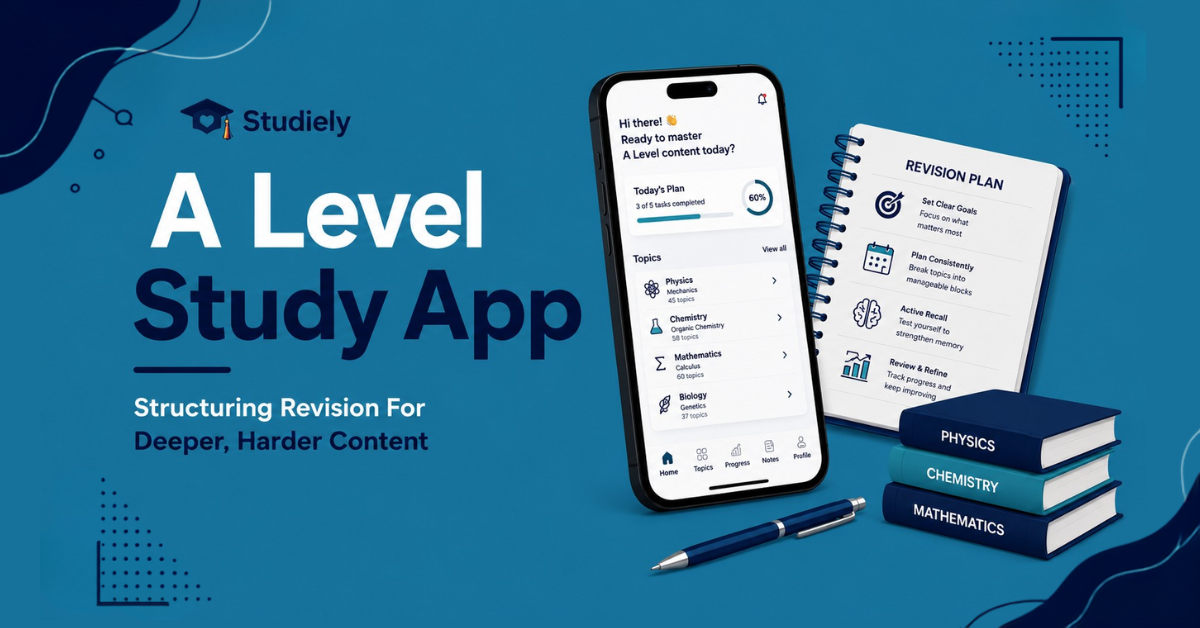
AI in Education
An A Level study app is digital software built to help students revise the more advanced, analytical content that A Levels require, offering structured practice, exam board-aligned questions, and progress tracking across each subject. Unlike GCSE tools, effective A Level apps need to support deeper analytical thinking, not just content recall.
The jump from GCSE to A Level catches many students off guard. Content becomes more analytical, exams demand extended written responses rather than short answers, and the volume of independent study required increases sharply. An A Level study app needs to be built specifically around these demands, not simply repurposed from GCSE-level tools with harder questions swapped in. At Studiely, we designed our A Level offering around this exact distinction, working with students and subject specialists to understand what genuinely supports success at this level.
This guide covers what makes an A Level study app effective, how revision strategy needs to shift from GCSE, and what to look for in a genuinely useful tool.
Why A Level Revision Needs a Different Approach
A Level exams place far greater weight on extended analysis, argument construction, and application of knowledge to unfamiliar contexts, compared to the more recall-focused structure of GCSEs. An A Level revision app built purely around flashcard-style content misses this entirely.
Time management also becomes more complex. Students juggling three or four A Level subjects, often alongside coursework or personal statements, need a study tool that helps them prioritise revision time strategically rather than treating every topic as equally urgent.
The stakes are also different — A Level results directly determine university offers, which adds pressure that GCSE study rarely carries. An effective A Level exam prep tool needs to build genuine confidence in exam technique, not just content familiarity.
Core Features of an Effective A Level Study Tool
Extended-response practice is essential. A Level revision app features should include structured essay or long-answer practice with model answers and mark scheme breakdowns, since these question types make up a significant portion of most A Level exams.
Exam board-specific content remains critical at this level too. A Level study tool content needs to reflect the specific requirements of AQA, Edexcel, OCR, or other relevant boards, since assessment objectives and command words vary in ways that materially affect how students should structure their answers.
Topic interlinking support is particularly valuable at A Level, since many subjects require students to draw connections across different parts of the syllabus. Tools that help students see these relationships, rather than treating each topic in isolation, better reflect how A Level exams are actually structured.
How Adaptive Technology Supports A Level Revision for UK Students
Adaptive A Level revision app systems track not just whether an answer is correct, but the quality and depth of extended responses, using this data to identify specific analytical weaknesses rather than just gaps in content knowledge.
Spaced repetition remains valuable at A Level, though it needs to work alongside deeper practice, not replace it. Recalling a fact is necessary but insufficient — students also need repeated practice applying that knowledge in exam-style analytical contexts.
Performance analytics that break down results by assessment objective, rather than just by topic, give students much clearer insight into whether they're struggling with knowledge, application, or evaluation — each of which requires a different revision strategy to address.
Building Independent Study Skills Through an A Level Study App
A Level study places significantly more responsibility on independent learning compared to GCSE. A well-designed study app should help build this independence by giving students clear ownership over their revision schedule, not simply pushing content at them passively.
Self-assessment tools that prompt students to evaluate their own extended answers against mark schemes build a valuable skill that carries directly into exam technique — the ability to recognise what separates a strong answer from an average one.
Progress tracking across the full A Level course, not just individual topics, helps students see how their understanding compounds over the two-year course, which is particularly motivating during the long stretch between mock exams and finals.
What to Look for in an A Level Revision App
Prioritise apps built with genuine subject specialist input, since A Level content requires more nuanced understanding than GCSE material to structure effectively into practice questions and model answers.
Check that the tool covers extended-response question types specifically, not just short-answer or multiple-choice formats, since these make up a substantial portion of most A Level assessment.
Look for transparent, evidence-based claims about how the tool supports revision — strong A Level exam prep tools should be able to explain their pedagogical approach clearly, not just market themselves on generic promises of improved grades.
How Studiely Supports A Level Students
Studiely's A Level tools are built around extended-response practice, exam board alignment, and assessment-objective-level performance tracking, designed specifically for the deeper analytical demands this level of study requires.
We work with subject specialists to keep content aligned with real exam board requirements, ensuring practice questions and model answers reflect genuine exam standards rather than generic approximations.
Our platform is built to support the two-year A Level journey specifically, helping students build both content mastery and the exam technique skills that separate strong results from average ones.
Final Thoughts
A Level revision demands more than content recall — it requires structured practice in analysis, argument construction, and exam technique. The right A Level study app supports this shift directly, rather than simply extending GCSE-level tools with harder questions.
Ready to revise smarter for your A Levels? Try Studiely today and get structured, exam board-aligned practice built specifically for A Level-level analytical demands.
Frequently Asked Questions
How is an A Level study app different from a GCSE study app?
A Level study apps focus more heavily on extended-response practice, analytical skill-building, and assessment-objective tracking, reflecting the deeper, more analytical nature of A Level exams compared to GCSEs.
Does an A Level revision app cover essay-based subjects effectively?
Effective A Level exam prep tools include structured essay practice with model answers and mark scheme breakdowns, which are essential for essay-heavy subjects like English, History, and Politics.
How many A Level subjects can I revise using one app?
Most comprehensive A Level study tools, including Studiely, support multiple subjects simultaneously, allowing students to manage revision across three or four A Levels within a single platform.
Is spaced repetition still useful at A Level, or just for GCSEs?
Spaced repetition remains valuable at A Level, though it works best when combined with deeper analytical practice rather than used as a standalone revision method.
When should students start using an A Level study app?
Starting at the beginning of Year 12 gives students the full two-year window to build content mastery and exam technique gradually, rather than compressing revision into the months before final exams.