 Studiely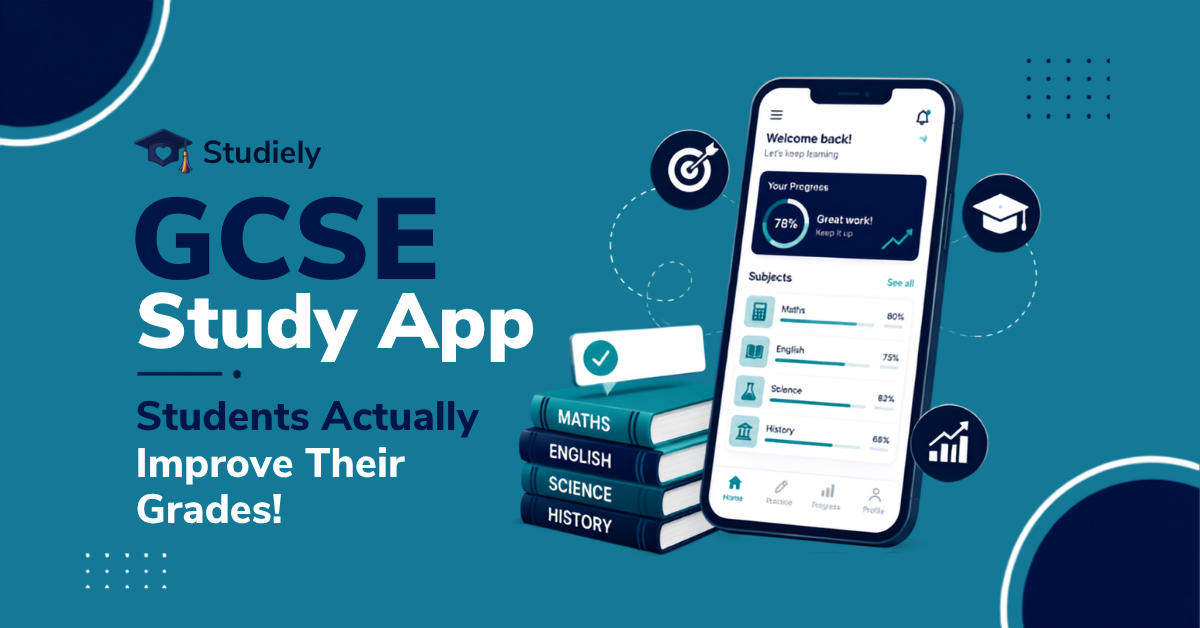
EdTech
A GCSE study app is digital software that helps students revise exam content, practise past questions, and track their progress against specific GCSE subjects. The most effective apps adapt to individual weak spots rather than presenting the same fixed revision material to every student.
GCSE students face a genuinely difficult challenge: revising multiple subjects at once, each with its own exam board specifics, while trying to figure out which topics actually need the most attention. A GCSE study app solves this by centralising revision content and giving students clear, structured feedback on where they stand. At Studiely, we've built our platform specifically around this problem, working closely with real GCSE students and teachers to understand what genuinely moves the needle on exam performance.
This guide explains what separates an effective GCSE study app from a generic revision resource, the technology that makes adaptive revision work, and what students and parents should look for.
Why Generic Revision Resources Often Fall Short
Textbooks and printed revision guides present the same content to every student, regardless of what they already know. A student who's confident in algebra but struggles with geometry still has to work through both sections at the same pace as everyone else.
A GCSE revision app addresses this directly by tracking individual performance and adjusting what gets shown next. Students spend more time on genuine weak spots instead of re-covering material they've already mastered, which makes revision time significantly more efficient.
Generic resources also rarely offer immediate feedback. When a student gets a practice question wrong in a textbook, they often don't find out why until a teacher marks it days later — by which point the specific confusion has usually faded from memory.
What Makes GCSE Exam Prep Genuinely Effective
Exam board alignment is non-negotiable. GCSE exam prep needs to reflect the specific board a student is sitting — AQA, Edexcel, OCR, or others — since question styles, mark schemes, and topic weighting vary meaningfully between them.
Spaced repetition is one of the most well-evidenced techniques for long-term retention, and a strong GCSE study tool builds this into its structure automatically, resurfacing topics at intervals designed to strengthen memory rather than leaving scheduling entirely up to the student.
Practice questions modelled closely on real exam format matter just as much as content coverage. Students who only study content summaries, without practising under exam-style conditions, often struggle with question interpretation and time management on the actual exam day.
The Technology Behind an Adaptive GCSE Study App
Adaptive revision relies on tracking granular performance data — which questions a student gets right, how long they take, and which topics they repeatedly struggle with. This data feeds into logic that determines what content or practice questions appear next.
Modern GCSE revision apps are typically built as cross-platform applications, allowing students to study consistently across phones, tablets, and computers. This matters because most GCSE students study in short bursts across different locations and devices throughout the day.
Progress dashboards give students and parents visibility into performance trends across subjects. Seeing concrete improvement over time — not just a raw score — tends to keep students more motivated through a demanding revision period.
How Students Should Structure GCSE Revision Using an App
Starting revision early and consistently outperforms last-minute cramming, and a good GCSE study tool supports this by breaking subjects into manageable daily or weekly sessions rather than presenting an overwhelming full syllabus at once.
Mixing subjects within a study session, rather than focusing on just one subject for hours, has been shown to improve retention. Apps that prompt students to rotate between subjects support this evidence-based approach automatically.
Reviewing mistakes properly matters more than simply completing more practice questions. Strong GCSE exam prep tools provide clear explanations for wrong answers, helping students understand the reasoning gap rather than just marking an answer incorrect and moving on.
What Parents Should Know About GCSE Study Apps
Not every GCSE study app is built with genuine pedagogical rigour behind it. Parents should look for apps developed with input from actual teachers and exam specialists, not just general app developers unfamiliar with UK exam board requirements.
Progress visibility for parents is a valuable feature, though it needs to be balanced carefully — students generally respond better to tools that build their own ownership over revision, rather than ones that feel like constant surveillance.
Data privacy also deserves attention, since these apps track detailed academic performance data for minors. A credible GCSE study app should be transparent about how student data is stored and protected.
Why Studiely Was Built Around Real Student Needs
Studiely was designed specifically for the GCSE revision experience, built around exam board-aligned content, spaced repetition, and clear progress tracking that students actually find motivating rather than overwhelming.
Our approach centres on adaptive practice that responds to genuine performance patterns, ensuring students spend their limited revision time on what will actually move their grades, not on content they've already mastered.
We work directly with UK secondary education specialists to keep our GCSE revision app aligned with real exam requirements, updating content as specifications and mark schemes evolve each academic year.
Final Thoughts
A well-designed GCSE study app turns scattered, inefficient revision into a structured, evidence-based process that adapts to each student's actual needs. The right tool doesn't just present content — it helps students understand exactly where to focus their limited time before exam day arrives.
Ready to make GCSE revision more focused and less overwhelming? Try Studiely today and see exactly where your revision time will make the biggest difference to your grades.
Frequently Asked Questions
What subjects does a GCSE study app typically cover?
Most GCSE revision apps, including Studiely, cover core and popular option subjects such as Maths, English, Sciences, Geography, History, and Languages, aligned to major UK exam boards.
Is a GCSE study app effective for all learning styles?
Adaptive GCSE exam prep tools work well for most students because they adjust to individual weak spots, though they work best when combined with active recall and consistent daily use rather than passive reading alone.
How early should students start using a GCSE revision app?
Starting in Year 10, or at the beginning of Year 11 at the latest, gives students enough time to benefit from spaced repetition and build strong content coverage before exams.
Do GCSE study apps align with specific exam boards like AQA or Edexcel?
Effective apps do, since question format, mark schemes, and topic weighting vary between exam boards, and content misaligned to the correct board can lead to wasted revision time.
Can parents track their child's progress on a GCSE study tool?
Most reputable apps offer progress dashboards for parents, though the best implementations balance this with giving students ownership over their own revision process.